If you've ever requested an ocean freight quote and then waited two, three, even five business days for a number back, you're not imagining the delay, and you're not doing anything wrong. You're running into a process that was built for a different era of freight, one that still runs on email chains, manual rate lookups, and a forwarder's personal Rolodex of carrier contacts.
Here's why that process is so slow, what it's actually costing you, and how an instant ocean freight quote changes the math entirely.
Why a "Simple" Ocean Freight Quote Takes So Long
Ask any importer who's shipped a 40ft container from Shanghai to Los Angeles and they'll tell you the quote itself is rarely the hard part. It's everything that happens *before* you get a number.
The rate isn't sitting in one place. Ocean freight pricing is fragmented across carriers, trade lanes, and contract structures. A traditional forwarder has to manually check spot rates with multiple carriers, cross reference any contract rates they hold, and then stitch together a quote by hand. With FCL rates from China to the US West Coast running $2,500 to $5,000 and East Coast rates significantly higher, and rates capable of moving sharply week to week, a forwarder working off a rate sheet from even a few days ago may already be quoting stale numbers.
Surcharges have to be tracked separately, and there are a lot of them. A real ocean freight quote isn't just the base rate. It includes Bunker Adjustment Factor (BAF), which alone typically adds $200 to $600 per container depending on route and fuel prices, plus Terminal Handling Charges, security fees, and increasingly, Peak Season Surcharges and General Rate Increases that carriers are required to publish but that still have to be manually applied to every quote. Get one of these wrong and the "quote" you send a customer bears little resemblance to the invoice they eventually receive.
Capacity is more concentrated than it used to be, which means availability checks take longer too. A small number of carrier alliances now control most global capacity, and that consolidation has made rates more volatile and space harder to confirm quickly, exactly the kind of environment where a manual, email-based quoting process falls furthest behind.
Humans are doing math that software should be doing. Multiply container count by rate, add surcharges, apply margin, format it into something presentable, then email it, and do that for every carrier option you want to offer a customer. It's not that forwarders are slow on purpose. It's that the tools most of them use were never built to do this in real time.
The result: what should be a same day decision turns into a multi-day back and forth, during which rates can move, space can disappear, and your customer is left waiting on a number they need to plan around.
What a Slow Quote Actually Costs You
A two to five day quote turnaround isn't just an inconvenience, it has real downstream cost.
You lose the rate you were quoted. With spot rates fluctuating week to week and General Rate Increases requiring only 30 days' advance notice, a quote that sat in someone's inbox for four days can already be out of date by the time you act on it.
You lose space. In a tighter capacity environment, the booking you were planning around may no longer be available at the price, or on the sailing, you expected.
You lose time on your own commitments. If you're quoting a customer, a slow forwarder quote becomes a slow customer quote. Every link in that chain compounds.
You lose visibility into total cost. Manual quotes are more prone to leaving out a surcharge or two, which is exactly how "the rate that looks competitive on the quote can look very different on the invoice," a pattern common enough that it's one of the most frequent complaints importers raise about traditional forwarders.
None of this is a minor inefficiency. It's friction that sits between you and a decision you need to make quickly in a market that doesn't wait.
How PortVelocity Built an Instant Ocean Freight Quote in Under 40 Seconds
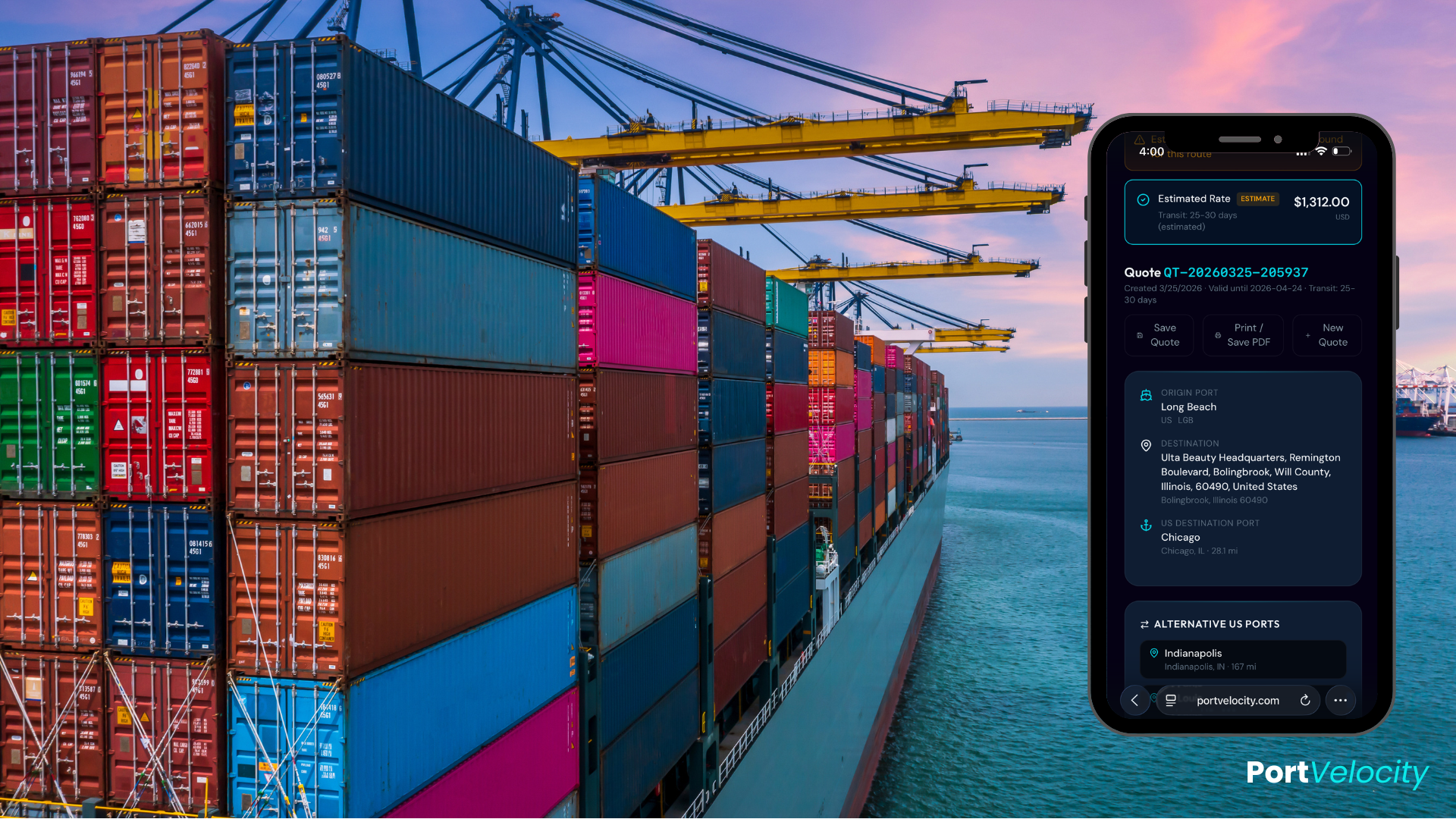
PortVelocity's Instant Quote module was built to remove that friction entirely. Instead of a manual lookup and email process, you get a live, multi-carrier ocean freight quote in under 40 seconds, accurate, all-in, and ready to act on.
Here's what makes that possible:
Real-time rate access, not a rate sheet from last week. The Instant Quote module pulls live spot rates directly through API integration, alongside any contract rates you've uploaded, so you're comparing current market pricing, not a snapshot that's already gone stale.
A side by side carrier matrix. Rather than a single number, you get a grid of carrier options across departure dates, tagged CHEAPEST, FASTEST, ESTIMATE, or CONTRACT, so you can see your full set of options and make the call yourself instead of waiting for someone else to make it for you.
All-in pricing, calculated automatically. Ocean freight, surcharges, drayage, customs, documentation: every cost category that belongs in a real landed-cost quote is built into the calculation from the start, so there's no surprise at invoice time.
Global port coverage. With autocomplete across more than 3,800 international ports and the major U.S. port and rail terminals, you're not limited to a handful of pre-set lanes. You get a real quote on the actual route you're shipping.
One click from quote to action. Once you have a quote, you can save it, send it as a branded PDF, or move straight into booking, no separate email thread, no reformatting, no second tool.
The difference isn't just speed for speed's sake. It's that an instant ocean freight quote means you're working with current pricing in a market where current pricing is the only kind that matters.
Why This Matters More in 2026 Than It Used To
Ocean freight pricing has always moved, but the pace and unpredictability of that movement has increased. Rates on major trade lanes have swung sharply within just a few weeks at points in 2026, driven by early peak-season demand, shifting carrier alliances, and capacity that's tighter than it's been in years. In that kind of environment, a quote that takes days to produce isn't just slow. It's often wrong by the time it lands in your inbox.
Speed has become a proxy for accuracy. The faster you can get a quote, the more likely it reflects what the market is actually doing right now, not what it was doing when someone started building your rate sheet three days ago.
Get Your Instant Ocean Freight Quote
You shouldn't have to wait days to know what your shipment costs. With PortVelocity's Instant Quote module, you get a real, all-in ocean freight quote, spot or contract, across thousands of global ports, in under 40 seconds.
Try a free instant ocean freight quote on your next trade lane
No account required. No sales call. Just a number you can actually act on.