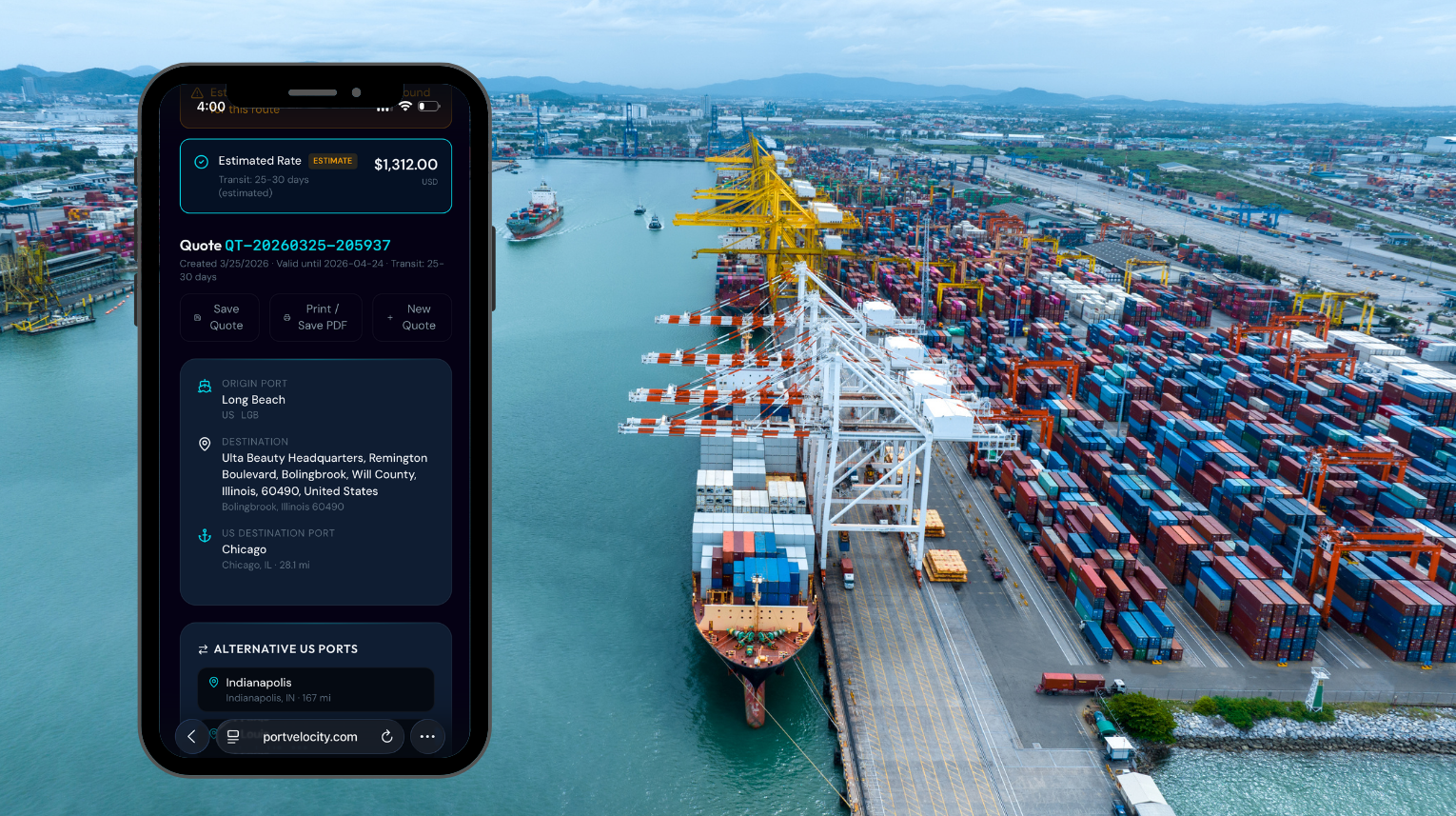
Every shipment starts with the same question: air freight vs ocean freight, which one actually makes sense for this load, this deadline, and this budget? For decades, that answer took days of back and forth with brokers, spreadsheets, and guesswork. Today, it takes seconds.
At PortVelocity, our AI powered Instant Quote module analyzes your shipment details in real time and tells you exactly when air freight wins, when ocean freight wins, and when a hybrid strategy is the smartest move, all before you've finished your coffee.
Air Freight vs Ocean Freight: The Core Tradeoffs
Before you can automate a decision, it helps to understand what's actually being weighed.
Speed
Air freight typically moves cargo in 1 to 5 days door to door. Ocean freight, depending on the trade lane, takes 20 to 45 days. If your shipment is time sensitive (a product launch, a perishable good, or a just in time manufacturing input) air freight often justifies its premium.
Cost
Ocean freight is dramatically cheaper per kilogram, especially for heavy or bulky cargo. Air freight pricing is driven by weight and volume (using dimensional weight calculations), which means low density, high value goods often fly more cost effectively than dense, low value goods.
Cargo Type and Volume
- Air freight suits small to mid volume shipments, high value electronics, pharmaceuticals, fashion, and urgent replacement parts.
- Ocean freight suits bulk commodities, furniture, machinery, and full container load (FCL) or less than container load (LCL) shipments where time pressure is low.
Reliability and Risk
Ocean freight is more exposed to port congestion, weather delays, and longer customs dwell times. Air freight has fewer touchpoints and generally more predictable transit windows, though capacity and pricing can swing sharply around peak seasons.
Environmental Impact
Ocean freight produces significantly lower carbon emissions per ton mile than air freight. For companies tracking ESG and Scope 3 emissions targets, this is increasingly a deciding factor, not an afterthought.
Why This Decision Is Harder Than It Looks
The textbook answer ("air for speed, ocean for cost") breaks down fast in the real world. Fuel surcharges shift weekly. Port congestion can erase ocean freight's cost advantage overnight. A shipment's dimensional weight can flip the math entirely. And most shippers are juggling dozens of these decisions across different lanes, carriers, and cargo profiles at once.
Manually comparing all these variables (current rates, transit times, carrier reliability scores, customs complexity, and carbon cost) for every shipment simply doesn't scale. That's the gap PortVelocity's AI was built to close.
How PortVelocity's Instant Quote Module Solves It
Our Instant Quote module removes the guesswork by pulling live data and applying machine learning models trained on historical shipping performance across thousands of lanes. Here's what happens in seconds:
- You enter shipment details: origin, destination, weight, dimensions, and target delivery date.
- The AI cross references live rates across air and ocean carriers, current fuel surcharges, and port congestion data.
- You get a side by side comparison of cost, transit time, reliability score, and estimated carbon footprint for both air freight and ocean freight options.
- The system flags the smarter choice based on your priorities, whether that's lowest cost, fastest transit, or lowest emissions, and lets you book directly.
No spreadsheets. No waiting on broker callbacks. No stale rate sheets. Just a clear, data backed recommendation you can act on immediately.
When AI Recommends Air Freight
- Deadlines under 10 days
- High value or fragile goods where damage risk during longer transit is costly
- Low density cargo where dimensional weight favors flying
- Markets with unpredictable ocean congestion
When AI Recommends Ocean Freight
- Shipments with 3+ weeks of lead time
- Heavy, bulky, or low value per kilogram goods
- Budget constrained shipments where cost outweighs speed
- Sustainability driven sourcing decisions
When AI Recommends a Hybrid Approach
Sometimes the smartest answer isn't "air or ocean," it's both. PortVelocity's Instant Quote module can flag hybrid strategies, such as shipping the bulk of an order by ocean while air freighting a smaller batch to meet an early deadline, giving you speed where it matters and savings everywhere else.
The Bottom Line
The air freight vs ocean freight decision used to require expertise, time, and a fair amount of guesswork. With PortVelocity's AI driven Instant Quote module, that expertise is built in, delivering a clear, data backed answer in seconds instead of days.
Ready to see your numbers? Run your next shipment through PortVelocity's Instant Quote module and get an instant, side by side comparison of air and ocean freight options tailored to your cargo, timeline, and budget.